








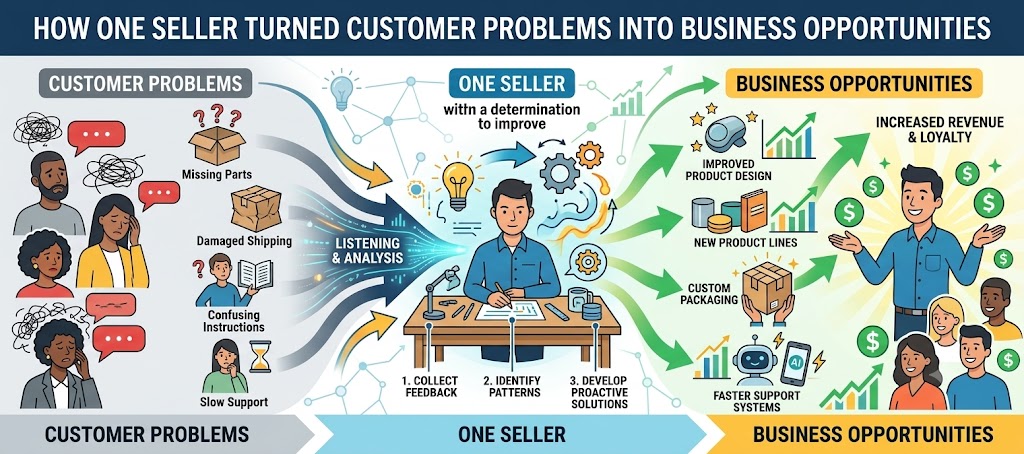
Every e-commerce business faces customer problems. A product may arrive late, customers may struggle to understand how to use it, packaging may not be convenient, or buyers may repeatedly ask for a feature that the seller never considered.
For some businesses, these issues are simply complaints to resolve. For others, they become valuable sources of business ideas.
One seller discovered that customer problems could reveal opportunities to improve products, strengthen service, and create new revenue streams. Instead of asking, “How can I stop customers from complaining?” the seller started asking, “What are customers trying to tell me?”
That change in perspective transformed the way the business operated.
For entrepreneurs in the UAE, where customers have diverse needs and online competition is constantly evolving, learning from customer problems can become an important part of building a sustainable e-commerce business.
It Started With a Simple Customer Complaint
The seller initially received a few complaints about a product.
Customers liked the product itself, but several people mentioned that they found it difficult to use or were unsure about certain features.
At first, the seller considered these normal customer-service issues.
But after receiving similar questions from multiple customers, a pattern became clear.
The problem was not necessarily the product.
The problem was the customer experience surrounding the product.
Instead of ignoring the feedback, the seller started documenting common questions and complaints.
This became the beginning of a new approach to business improvement.
Turning Complaints Into Information
Customer complaints can contain valuable information.
For example:
| Customer Problem | Possible Business Opportunity |
|---|---|
| Product is difficult to understand | Create better instructions or tutorials |
| Customers ask about different sizes | Introduce additional sizes |
| Customers want faster delivery | Improve logistics or stock locally |
| Packaging is inconvenient | Redesign packaging |
| Customers want related products | Add complementary products |
| Product information is unclear | Improve descriptions and images |
| Customers repeatedly ask the same question | Create an FAQ or educational content |
The important point is that not every complaint means the product is bad.
Sometimes it reveals an opportunity to make the entire customer journey better.
Listening for Repeated Problems
One customer complaint may be an isolated incident.
Ten customers mentioning the same issue is different.
The seller began tracking recurring feedback instead of treating every complaint separately.
Questions were grouped into categories such as:
-
Product quality
-
Product information
-
Pricing
-
Delivery
-
Packaging
-
Payment
-
Returns
-
Customer support
-
Product availability
This made it easier to identify recurring patterns.
For a growing e-commerce business, this type of simple feedback system can be extremely useful.
Improving the Product
One of the first opportunities came from customers requesting a small improvement to the original product.
The seller tested the change with a limited quantity rather than immediately redesigning the entire inventory.
Customers responded positively.
The improvement eventually became part of the standard product offering.
This demonstrates an important principle:
Customer feedback can become a form of product research.
Instead of relying entirely on assumptions about what customers want, sellers can use real purchasing experiences to identify practical improvements.
Creating a New Product From a Customer Need
The biggest opportunity came when customers repeatedly asked for something that was not included in the original product.
Initially, the seller recommended products from other businesses.
Eventually, the seller realized that the repeated demand could represent a new product opportunity.
After researching the market, suppliers, pricing, and customer demand, the seller introduced a complementary product.
The new product did not replace the original offering.
It expanded the business around an existing customer need.
This created an opportunity for cross-selling while also making the customer's shopping experience more convenient.
Making the Buying Experience Easier
Not every business opportunity needs to be a new product.
Sometimes the biggest opportunity is improving the purchasing process.
The seller discovered that customers were repeatedly asking questions that should have been answered on the product page.
The solution was simple:
-
Better product photographs
-
More detailed descriptions
-
Clear specifications
-
Frequently asked questions
-
Usage instructions
-
Delivery information
-
Clear return information
These changes reduced confusion and helped customers make purchasing decisions more confidently.
Using Customer Problems to Improve Content
The seller also noticed that customers were searching for information before making purchases.
Instead of treating these questions only as customer-service requests, the business turned them into content ideas.
For example:
Customer question: How do I use this product?
Content opportunity: Create a short tutorial.
Customer question: Which size should I choose?
Content opportunity: Create a size guide.
Customer question: What is the difference between these two products?
Content opportunity: Create a comparison guide.
This approach allowed the business to create content based on real customer needs rather than guessing what audiences might find useful.
Building Trust Through Transparency
Customer problems can also reveal where a business needs to communicate more clearly.
If customers frequently complain that a product looks different from their expectations, the seller may need better photographs or more accurate descriptions.
If customers are surprised by delivery times, the business may need clearer delivery information.
If customers do not understand return conditions, the policy may need to be explained more simply.
Transparency can reduce misunderstandings and strengthen customer confidence.
Improving Supplier Relationships
Sometimes customer problems originate further back in the supply chain.
If customers repeatedly receive products with inconsistent quality, the seller needs to investigate the supplier rather than simply handling each complaint individually.
The seller began monitoring supplier performance more carefully by checking:
-
Product quality
-
Packaging
-
Delivery consistency
-
Product specifications
-
Defect rates
-
Communication
-
Lead times
This created a more structured procurement process.
For UAE e-commerce businesses, reliable suppliers can be particularly important when customer expectations around product availability and delivery are high.
Customer Problems Can Reveal New Market Segments
Sometimes feedback reveals that a product is being used by customers in ways the seller never expected.
For example, a product originally marketed to one customer group may attract interest from another group.
Instead of immediately changing the entire brand strategy, the seller can test targeted marketing toward that new audience.
This can reveal additional market opportunities without requiring a completely new business model.
Not Every Customer Request Should Become a Product
There is an important lesson here.
Listening to customers does not mean saying yes to every request.
Some requests may come from only one person.
Others may be too expensive to implement.
Some may not fit the brand.
Others may have insufficient demand.
Before turning feedback into a business opportunity, sellers should ask:
-
How many customers have requested this?
-
Does the problem occur regularly?
-
Is there enough demand?
-
Can we provide the solution profitably?
-
Does it fit our existing business?
-
Can our suppliers support it?
-
Will it improve the customer experience?
This helps separate useful market signals from isolated requests.
Testing Opportunities Before Scaling
The seller learned to test ideas before making major investments.
For a new product, this could mean starting with a small quantity.
For a service improvement, it could mean testing a new process with a limited customer group.
For content, it could mean publishing several related pieces and measuring engagement.
Testing provides real information while reducing unnecessary risk.
A simple cycle can be:
Identify → Research → Test → Measure → Improve → Scale
Using Data Alongside Customer Feedback
Customer feedback is valuable, but it should be combined with business data.
For example, customers may say they want a particular product, but actual sales data may show limited demand.
Similarly, a product may generate strong sales despite receiving little direct feedback.
Sellers can combine:
-
Customer reviews
-
Support questions
-
Sales data
-
Search behavior
-
Return rates
-
Conversion rates
-
Repeat purchases
-
Product margins
Together, these sources provide a more complete picture.
Building a Customer-Centered Business
The seller eventually realized that customer feedback should not belong only to the customer-service department.
It could influence:
Product development
What should be improved or added?
Marketing
What problems should content address?
Operations
Where are delays or mistakes occurring?
Procurement
Which suppliers consistently deliver quality?
Website design
What information do customers struggle to find?
Customer service
Which questions appear repeatedly?
This created a business where customer insights influenced multiple areas of decision-making.
Understanding the UAE Market
For sellers operating in the UAE, customer feedback can be especially valuable because the market includes diverse audiences with different preferences, expectations, and purchasing habits.
A seller should avoid assuming that one customer's preference represents the entire market.
Instead, businesses can segment feedback by:
-
Customer type
-
Product category
-
Location
-
Purchase frequency
-
Price range
-
Use case
This can help identify more specific opportunities.
Businesses should also ensure that product changes, marketing practices, consumer policies, payments, and other operations comply with the requirements applicable to their particular activity and emirate.
The Business Lesson: Problems Can Be Signals
The seller's biggest change was not a new product or advertising campaign.
It was a change in perspective.
A complaint was no longer automatically viewed as a negative event.
Instead, the seller began asking:
What caused this problem?
Is this happening to other customers?
Can we solve it better?
Could the solution create additional value?
This approach transformed everyday customer interactions into a continuous source of business learning.
Practical Lessons for Other E-commerce Sellers
1. Keep Track of Customer Problems
Do not rely only on memory. Record recurring complaints, questions, and requests.
2. Look for Patterns
One complaint may be isolated. Repeated complaints can indicate a larger opportunity.
3. Improve Before Expanding
Sometimes the best business opportunity is improving an existing product or customer experience.
4. Test New Ideas
Use small experiments before making large investments.
5. Combine Feedback With Data
Customer opinions are useful, but sales, returns, conversion, and profitability provide additional context.
6. Solve Real Problems
The strongest opportunities often come from genuine customer needs rather than ideas created only because something appears trendy.
7. Keep the Customer at the Center
Every product, service, and process should ultimately create useful value for the customer.
Final Thoughts
Successful e-commerce businesses do not simply sell products. They solve problems.
The seller in this story learned that customer complaints, questions, and requests could provide valuable clues about what the market needed.
A packaging complaint could lead to better packaging.
A product question could lead to better content.
A repeated request could lead to a new product.
A delivery problem could lead to better logistics.
A confusing product page could lead to a better buying experience.
For UAE sellers, this customer-focused approach can help create stronger products, better service, and more sustainable business opportunities.
The most important lesson is simple:
Don't just solve the customer's problem once. Look for what the problem is teaching you about your business.
When sellers learn to listen, analyze, test, and improve, everyday customer challenges can become a powerful source of innovation and growth.
Customer Ratings & Review
Robert Fox
Verified purchase
Very nice ! On the other hand, we denounce with righteous indignation and dislike men who are so beguiled and demoralized by the
was this review helpful to you?
Thank (234) Dislike (12)Jenny Wilson
Verified purchase
Very nice ! On the other hand, we denounce with righteous indignation and dislike men who are so beguiled and demoralized by the
was this review helpful to you?
Thank (234) Dislike (12)Brooklyn Simmons
Verified purchase
Very nice ! On the other hand, we denounce with righteous indignation and dislike men who are so beguiled and demoralized by the
was this review helpful to you?
Thank (234) Dislike (12)