








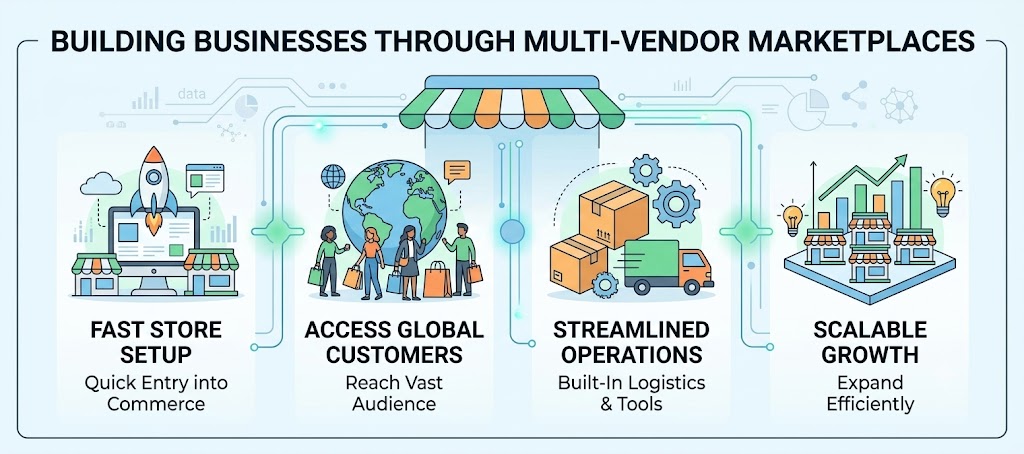
The way people start and grow businesses has changed significantly with the rise of e-commerce.
Entrepreneurs no longer need to build every part of an online shopping platform themselves. Multi-vendor marketplaces allow multiple sellers to offer products through one digital platform while customers can discover, compare, and purchase products from different businesses in one place.
For entrepreneurs, this creates an opportunity to build businesses around products, services, niche markets, sourcing, customer experience, and specialized product categories.
For the UAE market, where digital commerce continues to create opportunities for businesses of different sizes, multi-vendor marketplaces can provide an accessible environment for entrepreneurs who want to establish an online presence and reach customers beyond a traditional physical store.
What Is a Multi-Vendor Marketplace?
A multi-vendor marketplace is an online platform where multiple independent sellers can list and sell their products or services.
Unlike a traditional online store that sells products from one business, a marketplace brings different sellers together under one platform.
A typical marketplace ecosystem includes:
Platform Owner → Sellers → Products → Customers → Orders → Payments → Delivery → Reviews
The marketplace provides the infrastructure, while individual sellers manage their own businesses within that ecosystem.
Depending on the platform, sellers may be responsible for activities such as:
-
Product sourcing
-
Pricing
-
Inventory
-
Product listings
-
Order fulfillment
-
Customer support
The platform may provide tools for:
-
Seller registration
-
Product management
-
Payments
-
Order management
-
Marketing
-
Analytics
-
Customer communication
This structure creates opportunities for both marketplace operators and entrepreneurs who want to become sellers.
Why Entrepreneurs Are Interested in Multi-Vendor Marketplaces
Building an independent e-commerce website can require significant investment in technology, marketing, inventory, payment systems, and customer acquisition.
A multi-vendor marketplace can provide entrepreneurs with an existing digital environment where they can focus more heavily on their products and customers.
Some potential advantages include:
-
Access to an existing customer base
-
Lower initial technology requirements
-
Easier product discovery
-
Multiple product categories
-
Opportunities for niche businesses
-
Seller management tools
-
Centralized marketplace infrastructure
However, joining a marketplace does not guarantee sales.
Entrepreneurs still need to understand their customers, select appropriate products, maintain quality, manage pricing, and provide a reliable experience.
1. Entrepreneurs Are Starting With Niche Product Categories
One common approach is to focus on a specific product category instead of trying to sell everything.
A seller might specialize in:
-
Home organization
-
Beauty products
-
Electronics accessories
-
Fashion
-
Sports products
-
Baby products
-
Office supplies
-
Specialty foods
-
Lifestyle products
A focused category can make it easier for entrepreneurs to understand their customers and create a clear product strategy.
Instead of asking:
“What can I sell?”
entrepreneurs can ask:
“Which customer group can I serve particularly well?”
That change in thinking can lead to a more focused business model.
2. They Are Testing Products Before Expanding
A multi-vendor marketplace can also act as a testing environment.
An entrepreneur does not necessarily need to launch with dozens of products.
They can begin with a smaller selection and observe:
-
Customer interest
-
Sales performance
-
Reviews
-
Return rates
-
Pricing response
-
Product questions
-
Repeat purchases
If one product performs particularly well, the entrepreneur can investigate why.
The product may have:
-
Strong demand
-
Good pricing
-
A clear customer benefit
-
Low competition
-
Strong repeat-purchase potential
This information can guide future product expansion.
3. Entrepreneurs Are Turning Customer Problems Into Business Ideas
Many successful online businesses begin with a problem rather than a product.
Entrepreneurs may notice that customers struggle with:
-
Finding a particular product
-
Comparing products
-
Getting reliable service
-
Accessing specialized items
-
Understanding product specifications
-
Receiving products conveniently
These problems can become opportunities.
For example, if customers repeatedly struggle to find a specific type of product, an entrepreneur may build a focused product range around that need.
The marketplace provides the selling environment.
The entrepreneur provides the solution.
4. Multi-Vendor Marketplaces Can Lower the Barrier to Online Selling
Starting an e-commerce business independently can require several components:
-
Website development
-
Hosting
-
Payment integration
-
Product management
-
Security
-
Order management
-
Customer support
-
Marketing
A marketplace can provide many of these capabilities as part of its platform.
This can allow entrepreneurs to focus more attention on:
Product + Customer + Marketing + Operations
rather than building every technical component from scratch.
However, sellers should still understand the marketplace's fees, policies, seller requirements, and responsibilities before joining.
5. Entrepreneurs Are Building Brands Within Marketplaces
A marketplace does not mean that every seller has to look the same.
Entrepreneurs can still develop recognizable brands through:
-
Product presentation
-
Packaging
-
Photography
-
Product descriptions
-
Customer service
-
Brand messaging
-
Product quality
Consistency matters.
When customers repeatedly experience the same quality and communication, they begin to associate those experiences with the seller.
Over time, a marketplace seller can develop a recognizable identity beyond individual product listings.
6. They Are Using Customer Reviews as Business Intelligence
Customer reviews are valuable for more than attracting future buyers.
They can help entrepreneurs understand what customers actually think about their products.
Reviews may reveal:
-
Product strengths
-
Product weaknesses
-
Packaging problems
-
Delivery concerns
-
Missing features
-
Customer expectations
For example, if customers repeatedly praise a particular product feature, the seller may emphasize that feature in future marketing.
If customers repeatedly complain about packaging, the seller can improve it.
This creates a continuous improvement cycle:
Sell → Listen → Improve → Sell Better
7. Entrepreneurs Are Expanding Through Related Products
Once a seller understands a particular customer group, expanding into related products can become easier.
For example, a seller specializing in home organization may eventually add:
-
Storage products
-
Kitchen organizers
-
Closet accessories
-
Desk organization products
The advantage is that the new products target customers the seller already understands.
This can also create opportunities for:
-
Cross-selling
-
Product bundles
-
Higher order values
-
Repeat purchases
The key is to expand logically rather than simply increasing the number of products.
8. They Are Building Businesses Around Customer Convenience
Convenience is an important part of online shopping.
Entrepreneurs can create value by making the buying process easier.
This may include:
-
Clear product information
-
Simple navigation
-
Useful product filters
-
Multiple product options
-
Transparent pricing
-
Reliable delivery
-
Easy customer support
A seller does not always need a revolutionary product to create value.
Sometimes the opportunity lies in providing a better buying experience.
9. Multi-Vendor Marketplaces Create Opportunities for Small Businesses
A small business may not have the resources to operate a large independent online store.
A marketplace can provide an additional digital sales channel.
For small businesses, this can support:
-
Online visibility
-
Product discovery
-
New customer acquisition
-
Digital sales
-
Brand exposure
-
Expansion beyond local customers
This can be particularly useful for entrepreneurs who are transitioning from traditional retail or offline businesses into e-commerce.
10. Entrepreneurs Are Combining Offline Knowledge With Online Selling
Not every marketplace entrepreneur starts as a digital expert.
Some already understand a particular industry.
They may have experience in:
-
Retail
-
Wholesale
-
Manufacturing
-
Import and export
-
Distribution
-
Fashion
-
Food
-
Technology
-
Home products
That industry knowledge can become a competitive advantage when moving online.
An entrepreneur who understands customer needs, suppliers, product quality, and pricing may be able to build a stronger online product offering.
11. Data Is Helping Entrepreneurs Make Better Decisions
One of the biggest advantages of digital commerce is access to data.
Marketplace sellers can potentially monitor:
-
Product views
-
Orders
-
Conversion rates
-
Revenue
-
Customer reviews
-
Returns
-
Average order value
-
Inventory movement
This information can help answer important questions.
Which products are customers interested in?
Which products actually convert?
Which products generate repeat purchases?
Where are customers dropping out of the buying process?
The answers can help entrepreneurs make more informed decisions about inventory, pricing, and marketing.
12. Entrepreneurs Are Learning From Failed Products
Not every product will succeed.
A product may receive very little attention.
Another may receive many views but few orders.
A third may sell initially but generate too many returns.
These outcomes provide information.
Instead of simply removing a product and forgetting about it, entrepreneurs can investigate:
-
Was the price wrong?
-
Was the product description unclear?
-
Was the audience incorrect?
-
Was the product quality insufficient?
-
Was the competition too strong?
-
Was there simply insufficient demand?
Failure can become useful when it produces a lesson that improves the next decision.
13. Supplier Management Becomes a Core Business Skill
A marketplace can provide the digital platform, but entrepreneurs still need reliable products.
Supplier relationships can affect:
-
Quality
-
Availability
-
Pricing
-
Delivery
-
Customer satisfaction
-
Profitability
Entrepreneurs should evaluate suppliers carefully and avoid relying entirely on assumptions.
Useful considerations include:
-
Product samples
-
Quality consistency
-
Lead times
-
Communication
-
Pricing
-
Minimum order quantities
-
Scalability
As the business grows, supplier reliability becomes even more important.
14. Entrepreneurs Are Focusing on Customer Retention
Getting the first order is important.
Getting the second order can be even more valuable for a growing business.
Entrepreneurs can encourage repeat purchases through:
-
Consistent quality
-
Good customer service
-
Relevant product recommendations
-
Useful communication
-
Loyalty programs
-
Product bundles
-
New product launches
The objective is not simply to increase the number of transactions.
It is to build customer relationships that create long-term value.
15. Multi-Vendor Platforms Can Create Opportunities for Local UAE Businesses
The UAE has a diverse business environment with companies ranging from small retailers and specialist sellers to established businesses.
A multi-vendor marketplace can provide an additional digital channel for these businesses.
For local sellers, opportunities may include:
-
Reaching new customer segments
-
Expanding online visibility
-
Testing new products
-
Developing digital sales channels
-
Building an online brand
-
Reaching customers beyond their immediate location
However, businesses still need to consider their target audience, product-market fit, logistics, pricing, and customer expectations.
16. Entrepreneurs Are Using Content to Build Trust
Selling products online requires customers to make decisions without physically examining the product.
Content can help reduce uncertainty.
Entrepreneurs can create:
-
Buying guides
-
Product tutorials
-
Comparison articles
-
FAQs
-
Demonstration videos
-
Product education
-
Customer stories
Useful content can help customers understand products and can also demonstrate the seller's knowledge.
This can be particularly useful for specialized or technical products.
17. They Are Using Multiple Marketing Channels
A marketplace listing alone may not always generate enough visibility.
Entrepreneurs can use multiple channels to bring attention to their products, depending on their target customers.
These may include:
-
Social media
-
Search engines
-
Email marketing
-
Content marketing
-
Influencer partnerships
-
Paid advertising
-
Customer referrals
The important point is to measure results.
Marketing should not be based only on views, likes, or followers.
Entrepreneurs should also consider whether marketing activity contributes to meaningful business outcomes.
18. They Are Building Systems Before Scaling
Growth can create new problems.
A seller who manages 10 orders a day manually may struggle when order volume reaches 100 or more.
Entrepreneurs therefore need systems for:
-
Inventory
-
Orders
-
Customer support
-
Supplier management
-
Accounting
-
Returns
-
Marketing
-
Reporting
Simple systems can make growth more manageable.
The objective is to ensure that increasing sales does not automatically create a declining customer experience.
19. They Are Treating Challenges as Learning Opportunities
Multi-vendor businesses can face many challenges.
For example:
| Challenge | Potential Business Lesson |
|---|---|
| Low sales | Reconsider product-market fit |
| High returns | Improve product information or quality |
| Stockouts | Improve inventory planning |
| Supplier delays | Develop better sourcing processes |
| Negative reviews | Identify customer experience problems |
| High advertising costs | Improve conversion and marketing efficiency |
| Low repeat purchases | Improve customer experience |
| Too many support questions | Improve product information |
The problem itself is not automatically an opportunity.
The opportunity comes from identifying the underlying cause and making a useful improvement.
Building a Sustainable Multi-Vendor Business
A successful marketplace ecosystem requires more than having many sellers.
It needs a balance between:
Customers + Sellers + Products + Technology + Trust + Operations
Customers need good products and reliable service.
Sellers need access to customers and useful tools.
The marketplace needs efficient technology and clear processes.
When these elements work together, the platform can create value for everyone involved.
For entrepreneurs, this means understanding that success is not simply about uploading products.
It is about building a business that consistently delivers value.
What Entrepreneurs Should Consider Before Joining a Marketplace
Before choosing a multi-vendor platform, sellers should evaluate:
Marketplace Audience
Does the platform attract the type of customers the business wants to reach?
Fees
Understand commissions, subscriptions, payment fees, advertising costs, and other potential charges.
Seller Policies
Read the rules around listings, returns, customer service, and account management.
Logistics
Understand who manages shipping, fulfillment, and delivery responsibilities.
Competition
Consider how many sellers offer similar products.
Customer Support
Understand what support the marketplace provides and what remains the seller's responsibility.
Growth Potential
Consider whether the marketplace can support the business as its product range and order volume increase.
Making these considerations early can help entrepreneurs choose a platform that fits their business model.
The Future Opportunity for Entrepreneurs
Multi-vendor marketplaces can continue to create opportunities for entrepreneurs who understand how digital commerce works.
The biggest opportunity may not simply be selling more products.
It may be building businesses around:
-
Specific customer needs
-
Specialized product categories
-
Better experiences
-
Strong supplier networks
-
Local market knowledge
-
Data-driven decision-making
-
Customer relationships
Entrepreneurs who combine these capabilities can build businesses that are more adaptable as customer expectations change.
Final Thoughts
How entrepreneurs are building businesses through multi-vendor marketplaces is ultimately a story about accessibility, experimentation, and continuous improvement.
An entrepreneur can start with a small product range and gradually learn from customers.
They can test products, improve listings, develop supplier relationships, analyze data, build a brand, and expand into related categories.
The marketplace provides the infrastructure and environment.
But the entrepreneur still has to create the value.
For UAE businesses, multi-vendor marketplaces can provide an additional path toward digital commerce and customer reach. The most important step is not simply joining a marketplace—it is developing a clear understanding of the customer, choosing the right products, maintaining quality, and building systems that can support sustainable growth.
A marketplace can provide the opportunity. A strong business is built through what the entrepreneur does with it.
SEO Meta Description
Discover how entrepreneurs are building businesses through multi-vendor marketplaces using niche products, customer insights, digital tools, strong branding, and scalable strategies in the UAE market.
Suggested SEO Keywords
-
multi-vendor marketplace UAE
-
UAE marketplace business
-
multi-vendor e-commerce
-
marketplace entrepreneurs
-
online business UAE
-
e-commerce entrepreneurs UAE
-
marketplace seller
-
multi-vendor e-commerce platform
-
UAE online marketplace
-
e-commerce business growth
-
digital entrepreneurship UAE
-
marketplace business model
Customer Ratings & Review
Robert Fox
Verified purchase
Very nice ! On the other hand, we denounce with righteous indignation and dislike men who are so beguiled and demoralized by the
was this review helpful to you?
Thank (234) Dislike (12)Jenny Wilson
Verified purchase
Very nice ! On the other hand, we denounce with righteous indignation and dislike men who are so beguiled and demoralized by the
was this review helpful to you?
Thank (234) Dislike (12)Brooklyn Simmons
Verified purchase
Very nice ! On the other hand, we denounce with righteous indignation and dislike men who are so beguiled and demoralized by the
was this review helpful to you?
Thank (234) Dislike (12)