








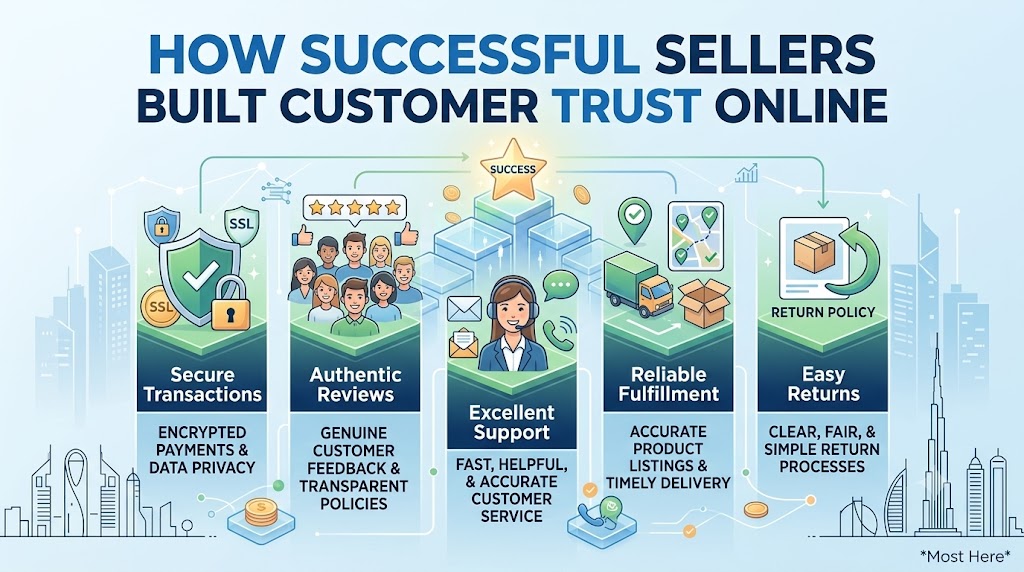
In e-commerce, getting a customer to visit your store is only the beginning.
The bigger challenge is convincing that customer to trust your business enough to place an order.
Unlike a physical shop, an online customer cannot always touch the product, speak face-to-face with the seller or inspect the packaging before buying. They make decisions based on product images, descriptions, reviews, pricing, policies, communication and the overall impression of the business.
This makes customer trust one of the most important foundations of e-commerce success.
For sellers in the UAE, where customers have access to many online shopping options, building trust can help a small business create stronger customer relationships and establish a professional reputation.
The good news is that trust does not always require a huge marketing budget.
It is built through consistent, honest and reliable customer experiences.
What Does Customer Trust Mean in E-commerce?
Customer trust means that shoppers feel confident about buying from a particular seller.
Before placing an order, a customer may silently ask:
-
Is this seller genuine?
-
Will I receive the product shown online?
-
Is the product description accurate?
-
Will my order arrive as promised?
-
Can I contact the seller if something goes wrong?
-
Is my payment and personal information handled appropriately?
-
What happens if I need to return the product?
Every part of the online shopping experience can influence these decisions.
A seller who answers these questions clearly can reduce uncertainty and make customers more comfortable purchasing.
1. Successful Sellers Keep Their Product Information Honest
One of the simplest ways to build trust is also one of the most important:
Show customers what they are actually buying.
Product descriptions should clearly explain:
-
Product features
-
Size and dimensions
-
Materials
-
Available variants
-
How the product is used
-
What is included
-
Important limitations
-
Relevant specifications
Avoid exaggerating product capabilities just to make a sale.
If a product looks different when it arrives than it appeared online, customer satisfaction can quickly decline.
Accurate information helps create realistic expectations before the order is placed.
2. They Use High-Quality Product Images
Online shoppers depend heavily on visuals.
A good product image should help customers understand:
-
Shape
-
Size
-
Colour
-
Design
-
Details
-
Packaging
-
How the product may look in use
Successful sellers do not necessarily need extremely expensive photography.
They need clear, relevant and accurate images.
Multiple useful angles can often answer questions that a single image cannot.
For example, showing the front, side, back, dimensions and product-in-use can give customers a much better understanding of what they are purchasing.
3. They Make Reviews Part of the Shopping Experience
Customer reviews provide social proof.
When shoppers see that other customers have purchased and experienced a product, they can gain additional information before making a decision.
Reviews can help customers understand:
-
Product quality
-
Actual usability
-
Size or fit
-
Packaging
-
Delivery experience
-
Customer service
For sellers, reviews also provide valuable feedback.
Positive reviews can highlight strengths.
Negative reviews can reveal areas that need improvement.
The objective should be to encourage genuine customer feedback, rather than trying to create an unrealistic picture of the business.
4. They Do Not Hide Negative Feedback
No growing business should expect every customer to have the same experience.
A negative review can be an opportunity to demonstrate professionalism.
Instead of becoming defensive, sellers can:
-
Acknowledge the concern.
-
Understand what happened.
-
Provide a helpful response.
-
Offer an appropriate solution where possible.
-
Learn from recurring problems.
For example, if customers repeatedly mention damaged packaging, the seller should investigate the packaging process.
If several customers say product information was unclear, the listing may need improvement.
A business can build trust not only through positive experiences, but also through the way it handles problems.
5. They Clearly Explain Delivery Information
Delivery is a major part of the online shopping experience.
Customers want to know:
-
When their order is expected
-
Where it will be delivered
-
Whether delivery charges apply
-
How they can track the order
-
What happens if there is a delay
Unclear delivery information can create uncertainty.
Successful sellers therefore communicate delivery expectations as clearly as possible.
If something changes, communicating with the customer can be better than leaving them without information.
6. They Make Return and Refund Policies Easy to Understand
Customers may hesitate to buy when they do not understand what happens if the product does not meet their expectations.
A clear policy should explain relevant information such as:
-
Eligibility
-
Time limits
-
Return process
-
Product condition requirements
-
Refund process
-
Applicable exclusions
Policies should be easy to find and written in straightforward language.
A complicated policy may create confusion even when the underlying process is reasonable.
7. They Respond to Customer Questions Professionally
A customer asking a question before purchasing is already showing interest.
The response can influence whether the sale happens.
Successful sellers try to make customer communication:
-
Clear
-
Polite
-
Helpful
-
Accurate
-
Timely
They do not simply reply with:
“Yes.”
Instead, they provide enough information to help the customer make a confident decision.
For example, rather than simply saying that a product is available, they can explain the available variant, relevant specifications and expected delivery information.
8. They Keep Their Pricing Transparent
Unexpected costs can damage customer confidence.
Sellers should make important pricing information clear wherever applicable, including:
-
Product price
-
Delivery charges
-
Discounts
-
Applicable fees
-
Promotional conditions
A customer should not feel that the price changed unexpectedly during the buying process.
Transparency creates a more predictable shopping experience.
9. They Build a Professional Online Presence
Customers often form an opinion about a business before buying anything.
A professional online presence can include:
-
Consistent branding
-
Clear product categories
-
Good-quality images
-
Useful product descriptions
-
Contact information
-
Customer support details
-
Clear policies
-
Updated information
A professional presentation does not mean that a seller needs a complicated website.
Even a simple online store can appear credible when the information is organised, accurate and regularly maintained.
10. They Show That There Are Real People Behind the Business
People often trust businesses more when communication feels human.
A small seller does not need to pretend to be a huge corporation.
Instead, the brand can communicate professionally while maintaining a human tone.
Helpful content can include:
-
Brand story
-
About-us information
-
Product education
-
Behind-the-scenes content
-
Customer experiences
-
Helpful buying guides
This can help customers understand who they are buying from and what the business stands for.
11. They Deliver What They Promise
Marketing can attract customers.
Delivery and product quality determine whether the promise is fulfilled.
If a seller advertises:
“Fast delivery”
but regularly delivers late, trust can suffer.
If a seller promises:
“Premium quality”
but customers receive inconsistent products, the brand's credibility can decline.
Successful sellers therefore understand an important principle:
Do not promise more than your business can consistently deliver.
Reliable execution is one of the strongest forms of trust-building.
12. They Keep Customers Informed After the Purchase
The customer journey does not end when payment is completed.
Post-purchase communication can make the experience more comfortable.
Depending on the business model, customers may benefit from:
-
Order confirmation
-
Shipping updates
-
Tracking information
-
Delivery notifications
-
Product-use information
-
Support after delivery
Good communication reduces uncertainty.
Customers should not have to repeatedly contact the seller simply to discover what is happening with their order.
13. They Protect Customer Information
Online businesses handle customer information that should be treated responsibly.
Sellers should take appropriate steps to protect information and use customer data according to applicable laws, regulations and platform requirements.
Trust can be damaged if customers believe their information is being handled carelessly.
This is why privacy and data protection should be considered part of the overall customer experience—not simply a technical issue.
14. They Treat Customer Complaints as Opportunities
A complaint tells a seller that something did not meet the customer's expectations.
The seller can ask:
What happened?
Then:
Why did it happen?
And finally:
How can we prevent it from happening repeatedly?
For example:
Complaint: Wrong product received
Possible issue: Order-picking process
Action: Improve inventory and fulfilment checks
Complaint: Product did not match expectations
Possible issue: Product description
Action: Improve images and information
Complaint: Customer did not know delivery status
Possible issue: Communication
Action: Improve order updates
This turns complaints into operational learning.
15. They Use Customer Feedback to Improve
Successful sellers do not simply collect reviews and forget about them.
They look for recurring patterns.
For example:
| Customer Feedback | Possible Improvement |
|---|---|
| Product size is unclear | Add detailed dimensions |
| Customers want more information | Improve product description |
| Packaging receives complaints | Review packaging materials |
| Customers praise quick delivery | Strengthen fulfilment process |
| Customers request another variant | Consider testing the new option |
| Repeated questions about usage | Add FAQs or instructions |
This creates a valuable cycle:
Feedback → Improvement → Better Experience → Stronger Trust
16. They Maintain Consistency as They Grow
Building trust once is not enough.
A seller needs to maintain it.
When order volumes increase, businesses can face pressure from:
-
Higher inventory requirements
-
More customer enquiries
-
More returns
-
Increased delivery activity
-
Supplier challenges
-
Larger marketing campaigns
If quality and service decline as sales increase, customer trust can suffer.
Successful sellers therefore work on systems that allow them to maintain consistent standards while growing.
17. They Build Trust Before Asking for Repeat Business
A customer who has had a positive experience is more likely to remember the seller.
But repeat business should not be based entirely on aggressive promotional messages.
Instead, sellers can focus on providing genuine value through:
-
Relevant product recommendations
-
Helpful information
-
New product updates
-
Useful customer support
-
Appropriate offers
The goal is to maintain the relationship rather than constantly pushing another sale.
18. They Understand That Trust Is More Than Reviews
Reviews are important, but they are only one part of the picture.
Customer trust is influenced by the entire journey:
First impression → Product discovery → Product information → Purchase → Payment → Delivery → Product experience → Customer support → After-sales service
A seller may have excellent reviews but poor delivery communication.
Another seller may have attractive products but unclear return policies.
A strong e-commerce experience requires different parts of the business to work together.
19. They Do Not Try to Manufacture Trust
Customers are becoming increasingly capable of identifying exaggerated marketing.
Trust cannot be sustainably created through:
-
Fake reviews
-
Misleading images
-
Unrealistic promises
-
Artificial claims
-
Hidden information
Instead, successful brands focus on building credibility through real customer experiences.
Authenticity is a business asset.
20. They Think About Trust as a Long-Term Investment
A seller may spend money to acquire a customer today.
But the customer's lifetime value can extend beyond the first order.
A satisfied customer may:
-
Purchase again
-
Recommend the business
-
Leave a positive review
-
Follow the brand
-
Share the product
-
Become a long-term customer
This means customer trust can support growth beyond a single transaction.
A Simple Trust-Building Framework for UAE Sellers
E-commerce sellers can use the following five-part framework:
1. Be Clear
Provide accurate product, pricing, delivery and policy information.
2. Be Visible
Maintain a professional and consistent online presence.
3. Be Responsive
Answer questions and handle problems professionally.
4. Be Reliable
Deliver the product and service that customers were promised.
5. Keep Improving
Use reviews, complaints and customer questions to improve the business.
These principles are simple, but applying them consistently can make a significant difference to the customer experience.
How a Small UAE Seller Can Build Trust Step by Step
A small business does not need to implement everything at once.
A practical starting point could be:
Step 1: Improve product images.
Step 2: Rewrite unclear product descriptions.
Step 3: Make delivery information easy to find.
Step 4: Clearly explain return and refund procedures.
Step 5: Encourage genuine customer reviews.
Step 6: Monitor recurring complaints.
Step 7: Improve the most common customer pain point.
Step 8: Keep communication consistent.
Step 9: Measure customer satisfaction and repeat purchases.
Step 10: Continue improving as the business grows.
Small improvements across these areas can gradually create a more trustworthy shopping experience.
Final Thoughts
Successful sellers understand that customer trust cannot be purchased through advertising alone.
It is earned through hundreds of small interactions.
An accurate product description.
A useful answer to a customer question.
A product that arrives as expected.
A clear return policy.
A genuine review.
A helpful response to a complaint.
A delivery update when the customer needs one.
Together, these experiences create the reputation of an e-commerce business.
For sellers in the UAE, building customer trust can provide an important foundation for long-term online growth. The businesses that consistently communicate clearly, deliver on their promises, listen to customers and improve their operations can create stronger relationships with the people who buy from them.
A customer may discover your product because of marketing, but trust is what can turn a first purchase into a lasting relationship.
Customer Ratings & Review
Robert Fox
Verified purchase
Very nice ! On the other hand, we denounce with righteous indignation and dislike men who are so beguiled and demoralized by the
was this review helpful to you?
Thank (234) Dislike (12)Jenny Wilson
Verified purchase
Very nice ! On the other hand, we denounce with righteous indignation and dislike men who are so beguiled and demoralized by the
was this review helpful to you?
Thank (234) Dislike (12)Brooklyn Simmons
Verified purchase
Very nice ! On the other hand, we denounce with righteous indignation and dislike men who are so beguiled and demoralized by the
was this review helpful to you?
Thank (234) Dislike (12)