








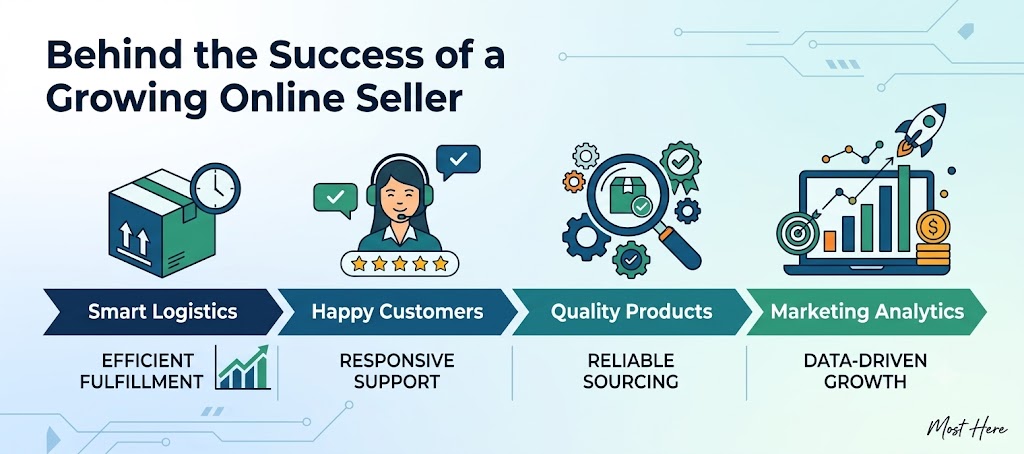
From the outside, a growing online store can look simple.
Customers see attractive products, good reviews, smooth ordering, and regular social media activity. What they do not always see is the work happening behind the scenes: product research, supplier management, inventory planning, customer service, marketing, data analysis, and constant improvement.
The success of a growing online seller is rarely the result of one lucky product or one successful advertising campaign. It is usually built through many small decisions made consistently over time.
For entrepreneurs and sellers in the UAE, understanding what happens behind a growing online business can provide useful lessons for building a stronger and more sustainable e-commerce operation.
What Really Happens Behind a Growing Online Business?
An online seller may start with a simple idea and a small number of products.
As orders increase, however, the business becomes more complex.
The seller must think about:
-
Where products come from
-
How much inventory to keep
-
How products are priced
-
How customers discover the business
-
How orders are fulfilled
-
How customer questions are handled
-
How returns are managed
-
Which products deserve more investment
-
How to maintain quality while growing
Growth therefore requires more than increasing sales.
It requires building the systems that can support those sales.
1. It Usually Starts With Understanding the Customer
Before successful sellers focus on growth, they need to understand who they are serving.
They study questions such as:
-
What does the customer need?
-
What problem are they trying to solve?
-
What influences their purchase?
-
What price range is acceptable?
-
What concerns prevent them from buying?
-
What makes them return?
This customer understanding helps shape product selection, pricing, marketing, and communication.
A seller who understands the customer is in a better position to create relevant products and experiences.
2. Product Selection Is a Major Part of the Story
A growing seller rarely succeeds simply by selling random products.
Product selection requires consideration of:
-
Demand
-
Competition
-
Quality
-
Cost
-
Profit margin
-
Supplier reliability
-
Shipping requirements
-
Customer expectations
-
Repeat-purchase potential
A product may generate attention but still be difficult to build a business around if margins are too low or supply is unreliable.
Successful sellers therefore look at the complete business model rather than focusing only on sales volume.
3. They Test Before They Invest Heavily
One of the practical lessons from growing online sellers is the value of testing.
Instead of purchasing large amounts of inventory immediately, sellers can start with smaller quantities and observe customer behavior.
They can measure:
-
Product views
-
Orders
-
Conversion rates
-
Customer feedback
-
Returns
-
Repeat purchases
This allows them to make decisions based on real market information.
If a product performs well, they can gradually increase investment.
If it performs poorly, they can investigate the reasons before committing additional resources.
4. They Build Reliable Supplier Relationships
Customers may never see a seller's suppliers, but suppliers can have a major impact on the customer experience.
Supplier performance affects:
-
Product quality
-
Inventory availability
-
Delivery timelines
-
Pricing
-
Customer satisfaction
Growing sellers therefore evaluate suppliers carefully.
They may monitor:
-
Quality consistency
-
Lead times
-
Communication
-
Pricing
-
Minimum order quantities
-
Production capacity
Having dependable suppliers can make it easier to maintain consistent customer experiences as order volumes increase.
5. They Understand Their Numbers
Sales revenue alone does not tell the complete story.
An online seller needs to understand the economics of each product.
Important figures can include:
-
Product cost
-
Selling price
-
Marketplace fees
-
Payment fees
-
Shipping costs
-
Packaging costs
-
Advertising expenses
-
Return costs
-
Gross margin
-
Customer acquisition cost
A product generating high sales may not necessarily generate healthy profits.
Growing sellers regularly review their numbers to understand which products and activities are contributing to the overall business.
6. They Create Product Listings That Answer Customer Questions
Customers cannot physically inspect most products online.
The product listing therefore has an important job.
A good listing should explain:
-
What the product is
-
Who it is designed for
-
Key features
-
Specifications
-
Dimensions
-
Materials
-
Available variations
-
How it should be used
-
What is included
High-quality images are equally important.
Clear product information reduces uncertainty and helps customers make informed purchasing decisions.
7. They Take Product Photography Seriously
Online customers often make their first judgment based on images.
Professional product photography can help communicate:
-
Product appearance
-
Size
-
Features
-
Quality
-
Usage
-
Packaging
The images do not always need to be expensive studio productions.
They need to be clear, accurate, consistent, and relevant.
A growing seller gradually learns which types of images help customers understand the product better.
8. Customer Feedback Becomes a Growth Tool
Customer feedback is one of the most valuable sources of information available to an online seller.
Feedback can come from:
-
Reviews
-
Ratings
-
Customer messages
-
Support conversations
-
Social media
-
Return reasons
-
Surveys
A growing seller looks for patterns.
If customers repeatedly mention the same issue, that issue deserves attention.
If customers repeatedly praise a particular feature, that feature may deserve greater emphasis in marketing.
This creates a continuous improvement cycle.
Listen → Analyze → Improve → Measure
9. They Treat Negative Reviews as Information
Negative reviews are not pleasant, but ignoring them can mean missing important information.
A seller can categorize negative feedback into:
Product Issues
Quality, functionality, sizing, or durability.
Information Issues
Customers did not understand the product correctly.
Delivery Issues
Late or damaged shipments.
Service Issues
Slow responses or unclear communication.
Once the underlying cause is understood, the seller can decide what needs to change.
The objective is not to eliminate every negative comment.
It is to identify legitimate problems and improve the customer experience.
10. They Build Customer Trust One Order at a Time
Trust is especially important in e-commerce because customers are purchasing without physically visiting a store.
Trust can be supported through:
-
Accurate product information
-
Genuine images
-
Clear policies
-
Reliable delivery
-
Professional communication
-
Consistent quality
-
Responsive customer support
-
Authentic customer reviews
One successful transaction creates a positive experience.
Repeated positive experiences can create stronger customer confidence in the business.
11. They Understand That Delivery Is Part of the Product Experience
For an online customer, the product experience does not begin when they open the package.
It begins when they place the order.
Customers may care about:
-
Order confirmation
-
Delivery updates
-
Expected delivery time
-
Packaging
-
Product condition
-
Communication when delays occur
A seller cannot always control every aspect of logistics, but they can create processes that improve communication and reduce avoidable problems.
12. They Manage Inventory With Discipline
Inventory management becomes increasingly important as sales grow.
Too little stock can cause missed sales.
Too much stock can tie up money and create storage problems.
Growing sellers monitor:
-
Best-selling products
-
Slow-moving products
-
Reorder levels
-
Supplier lead times
-
Seasonal demand
-
Sales trends
They use this information to make more informed purchasing decisions.
13. They Don't Depend on One Product Forever
A product that performs well can become the foundation for expansion.
Sellers can identify related products that appeal to the same customer.
For example, a business selling home organization products might expand into related storage accessories rather than immediately entering an unrelated category.
This approach can help create:
-
Cross-selling opportunities
-
Product bundles
-
Higher order values
-
More repeat purchases
Product expansion works best when it is connected to a clear customer need.
14. They Build a Recognizable Brand
A growing seller eventually needs to think beyond individual transactions.
Branding can include:
-
Business name
-
Logo
-
Product photography
-
Packaging
-
Colors
-
Communication style
-
Customer service
-
Product quality
Consistency helps customers recognize the business.
A strong brand does not require expensive design.
It requires a consistent experience.
15. They Use Content to Educate Customers
Not every customer is ready to buy immediately.
Helpful content can answer questions and build familiarity with the business.
Sellers can create:
-
Buying guides
-
Product comparisons
-
Tutorials
-
FAQs
-
Product demonstrations
-
Educational blog posts
-
Social media tips
Content can also help attract customers through search engines and social media.
The strongest content often starts with real customer questions.
16. They Measure Marketing Instead of Guessing
Growing sellers usually experiment with different marketing channels.
These might include:
-
Search
-
Social media
-
Paid advertising
-
Email
-
Influencer partnerships
-
Content marketing
-
Customer referrals
The important part is measurement.
Sellers can evaluate:
-
Traffic
-
Conversion
-
Customer acquisition cost
-
Revenue
-
Return on advertising spend
-
Repeat purchases
This helps them understand where marketing investment is generating useful business results.
17. They Know the Difference Between Traffic and Customers
A large number of website visitors can look impressive.
But traffic alone does not build a business.
A seller should also understand:
How many visitors purchase?
How much does each customer spend?
How many customers return?
Which products generate the most valuable customers?
This moves the focus from vanity metrics toward business performance.
18. They Focus on Repeat Customers
A growing seller does not want every month to begin with finding an entirely new group of customers.
Repeat customers can become an important part of sustainable e-commerce growth.
Businesses can encourage repeat purchases through:
-
Consistent quality
-
Good service
-
Relevant product recommendations
-
Loyalty programs
-
New product announcements
-
Helpful communication
-
Product bundles
The foundation remains simple:
Give customers a reason to come back.
19. They Turn Problems Into Better Processes
Growth brings challenges.
An order may be shipped incorrectly.
Inventory may be recorded incorrectly.
A supplier may deliver late.
A customer may receive incomplete information.
Instead of fixing only the individual problem, growing sellers ask:
“How can we prevent this from happening again?”
That can lead to:
-
Checklists
-
Standard operating procedures
-
Better inventory systems
-
Automated notifications
-
Quality-control processes
-
Clear customer-service procedures
These systems become increasingly valuable as the business grows.
20. They Prepare for Growth Before They Need It
A business that handles 10 orders per day may operate differently from one handling 500.
Manual processes that work at a small scale can become inefficient later.
Growing sellers gradually introduce appropriate tools for:
-
Inventory
-
Orders
-
Customer relationships
-
Accounting
-
Marketing
-
Analytics
-
Support
The goal is not to automate everything.
The goal is to remove unnecessary repetitive work and create consistency.
21. They Adapt to Changing Customer Expectations
Online customers continuously change their expectations.
They may want:
-
Faster delivery
-
Better product information
-
More payment options
-
Easier returns
-
Better mobile experiences
-
Faster customer support
-
More personalized recommendations
Growing sellers monitor these changes and adapt where they make sense.
Adaptation does not mean following every trend.
It means understanding which changes matter to the customers the business serves.
22. They Use Data Alongside Human Judgment
Data can tell a seller what is happening.
Customer conversations can sometimes explain why it is happening.
For example, sales data may show that a product is underperforming.
Customer feedback may reveal that the product description is confusing.
Both sources are useful.
Successful e-commerce businesses combine:
Data + Customer Feedback + Business Experience
to make better decisions.
23. They Keep the Customer at the Center
Behind many growing online businesses is a simple principle:
Make the customer experience better.
This includes every stage:
Before Purchase
Clear information and useful content.
During Purchase
Simple ordering and transparent pricing.
After Purchase
Reliable communication and delivery.
After Delivery
Support, feedback, and opportunities for future purchases.
Every interaction contributes to the customer's perception of the brand.
The UAE Opportunity for Growing Online Sellers
The UAE provides a diverse environment for e-commerce businesses, with opportunities across retail, lifestyle, technology, fashion, home products, food, and many specialized categories.
For sellers targeting UAE customers, several areas deserve particular attention:
Customer Understanding
Know the specific audience and their expectations.
Product Quality
Consistent quality is essential for building trust.
Convenience
Make the online buying experience clear and easy.
Fulfillment
Reliable delivery and communication can influence customer satisfaction.
Localization
Product messaging, pricing, service, and operations should be appropriate for the intended UAE customer segment.
Digital Visibility
A strong combination of marketplace presence, search visibility, social media, and useful content can help businesses reach potential customers.
Common Mistakes Growing Sellers Should Avoid
Growing Too Quickly
Rapid expansion without sufficient systems can create operational problems.
Ignoring Profit Margins
High sales do not automatically mean a healthy business.
Depending on One Product
A single successful product can be useful, but relying entirely on it can create risk.
Ignoring Existing Customers
Customer retention deserves attention alongside customer acquisition.
Copying Competitors
Competitor research is useful, but businesses need their own value proposition.
Neglecting Operations
Marketing can increase orders, but operations determine whether those orders can be fulfilled effectively.
What Really Happens Behind Sustainable Growth?
The visible part of a successful online business is usually the sales.
The invisible part is everything that makes those sales repeatable.
It includes:
Research → Product Selection → Sourcing → Listing → Marketing → Sales → Fulfillment → Customer Feedback → Improvement → Repeat
This cycle continues as the business grows.
The seller's role changes over time too.
At the beginning, the entrepreneur may handle almost everything personally.
As the business grows, the focus gradually shifts toward:
-
Managing people
-
Improving systems
-
Understanding data
-
Managing suppliers
-
Planning inventory
-
Building the brand
-
Making strategic decisions
That transition is an important part of e-commerce growth.
Final Thoughts
Behind the success of a growing online seller is rarely one secret strategy.
It is usually a combination of customer understanding, good products, reliable suppliers, disciplined operations, effective marketing, data, and continuous improvement.
The seller starts small.
They test.
They make mistakes.
They listen.
They improve.
They build systems.
Then they repeat what works.
For entrepreneurs in the UAE, this approach can provide a practical foundation for building a credible and sustainable online business.
A growing seller should therefore look beyond the number of orders and ask a more important question:
“Are we building a business that can consistently create value for customers as we grow?”
When the answer is supported by strong products, reliable operations, customer trust, and continuous learning, growth becomes more than increasing sales—it becomes the development of a stronger business.
SEO Meta Description
Discover what happens behind the success of a growing online seller, from product selection and customer trust to marketing, inventory, data, branding, and scalable operations in the UAE.
Suggested SEO Keywords
-
growing online seller
-
successful online seller
-
UAE e-commerce sellers
-
e-commerce business UAE
-
online business growth
-
e-commerce growth strategies
-
successful e-commerce business
-
UAE online business
-
marketplace seller
-
e-commerce customer experience
-
online selling strategies
-
e-commerce entrepreneurs
Customer Ratings & Review
Robert Fox
Verified purchase
Very nice ! On the other hand, we denounce with righteous indignation and dislike men who are so beguiled and demoralized by the
was this review helpful to you?
Thank (234) Dislike (12)Jenny Wilson
Verified purchase
Very nice ! On the other hand, we denounce with righteous indignation and dislike men who are so beguiled and demoralized by the
was this review helpful to you?
Thank (234) Dislike (12)Brooklyn Simmons
Verified purchase
Very nice ! On the other hand, we denounce with righteous indignation and dislike men who are so beguiled and demoralized by the
was this review helpful to you?
Thank (234) Dislike (12)